The infection lectures were delivered by Dr. Keat Choong, Dr Andrej Trampuz and Dr Nora Renz from Brisbane, Australia. The professional topics were delivered by Dr. Des Soares from Brisbane. Rheumatology was taught by Dr. Tracy Kain from Tauranga, New Zealand.
Blood culture bottles demonstrating colour change to yellow when positive for infection
Orthopaedic infection is a major issue in the Pacific with osteomyelitis and septic arthritis causing significant disability. Diagnosis and management of orthopaedic infection including periprosthetic infection and discussion of student case studies was a highlight.
Gout is extremely common and causes major illness in the Pacific. Tracey Kain taught is how to manage gout with confidence and to help patients help themselves. The infection and inflammatory conditions module was also concluded with an end of block written examination.
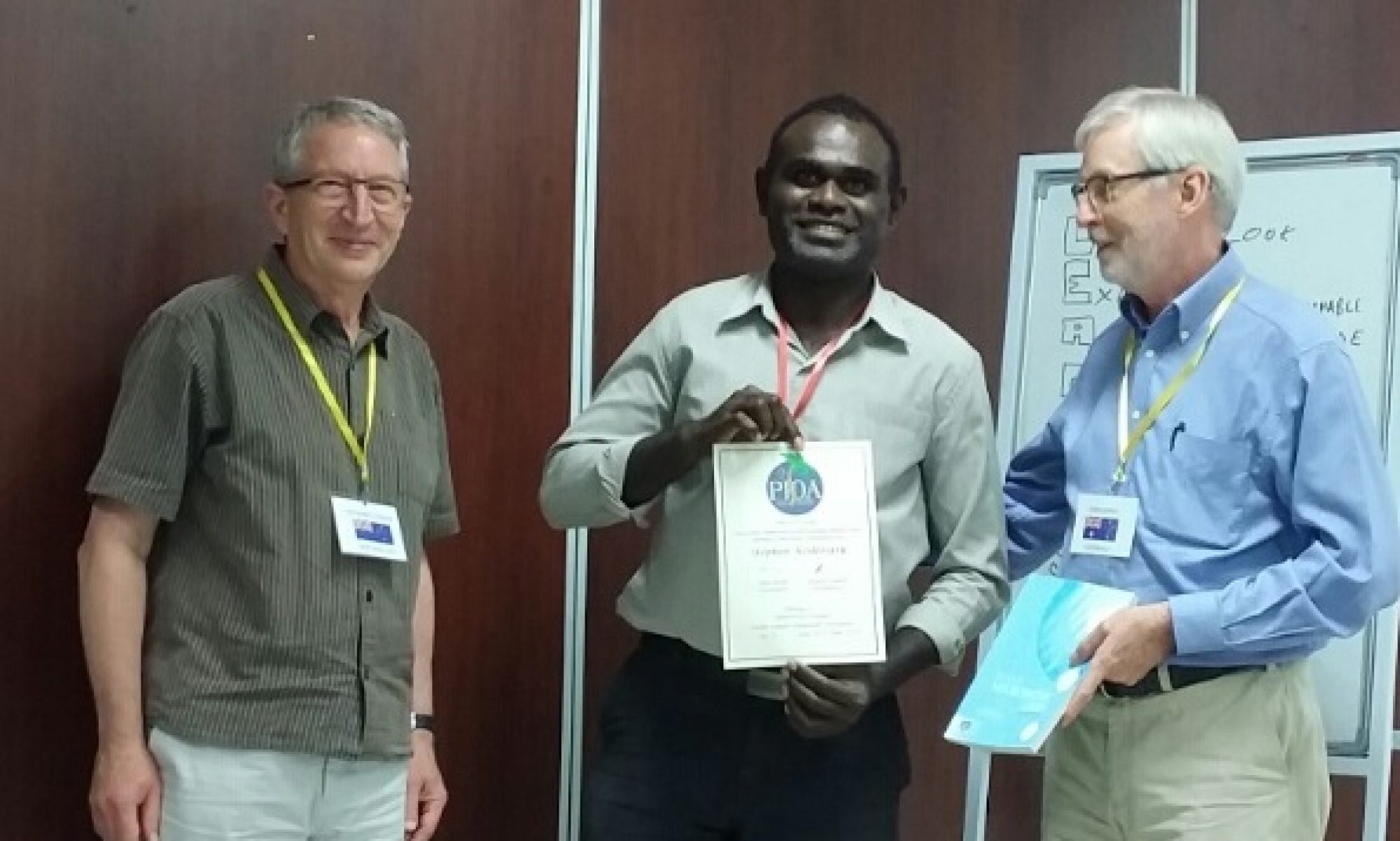
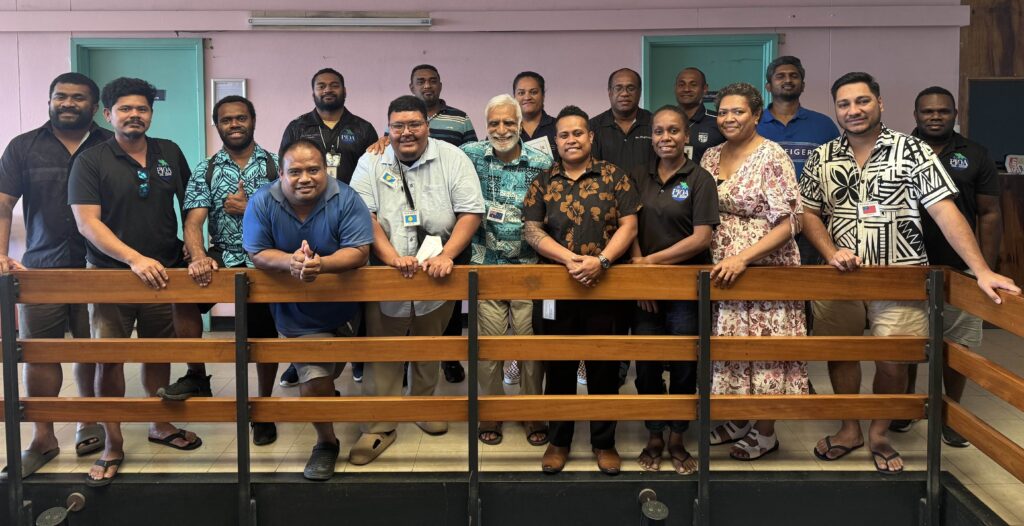
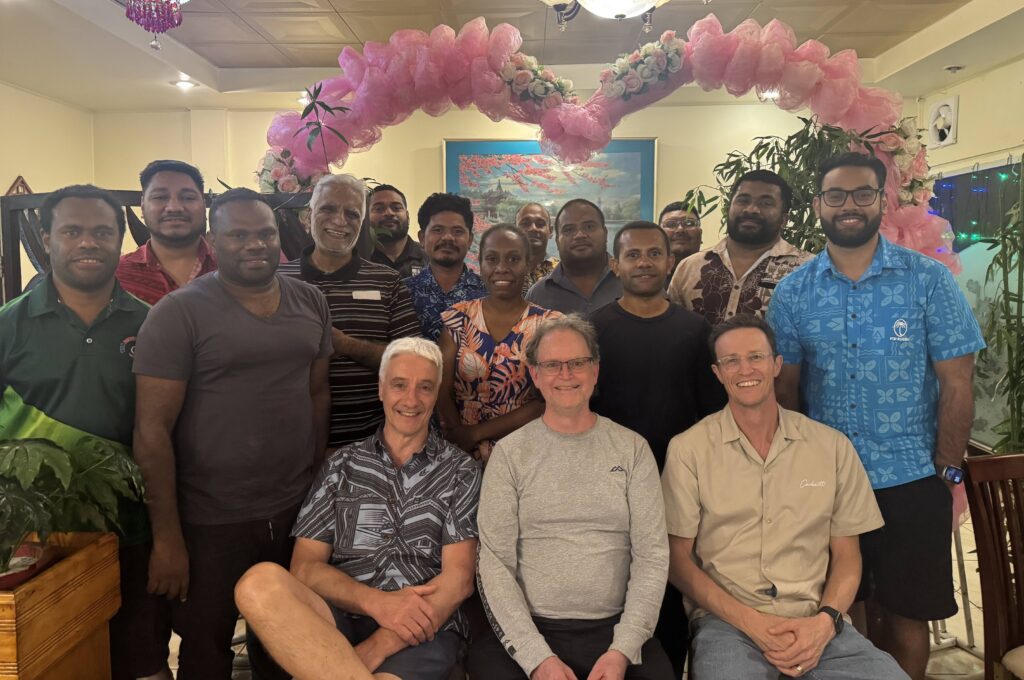
Front row Paul Lomavatu (Fiji), Oralae Pitakia (Solomon Islands), Tracey Kain ( Tauranga NZ), Andrej trampuz (Brisbane Australia), Nora Renz (Brisbane Australia), Keat Choong Sunshine Coast, Australia, manoa Valeniyasana (Lautoka Fiji). back row Des Soares (Brisbane), Taukoriri Tibriano (Kiribati), Vanua Ilo (Vanuatu), Robert Faataga (Samoa), Jeffrey Yiapi (Solomon Islands), Stephen Waro, PNG), Tzun Rafael (Palau), Michael Leota (Samoa)
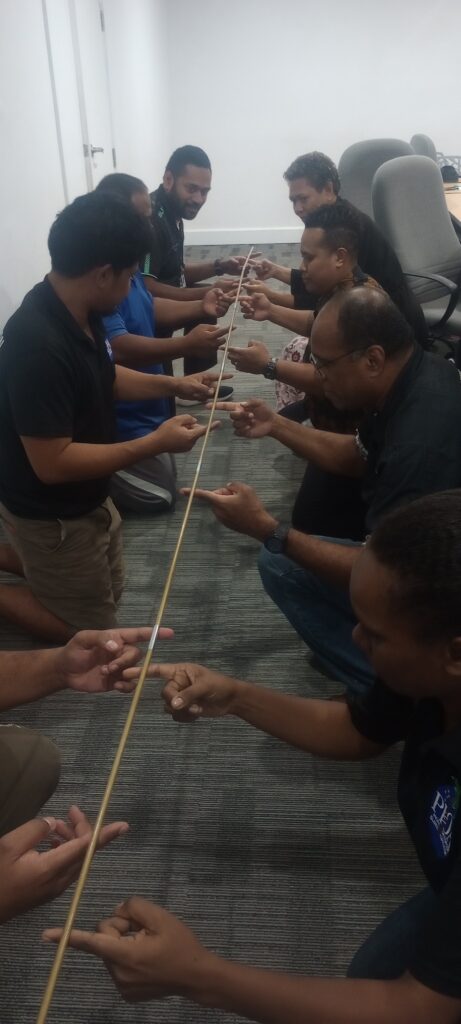
Teambuilding exercise – Helium stick
In the Professional topics we looked at issues like practice evaluation, audit and professional behaviour standards. Highlights included 2 multi-disciplinary workshops including other staff including surgeons, anaesthetists and nurses using modified courses for “Operating with Respect” and “Safer surgical Teams”/ These were enthusiastically received and have already led to significant improvements in communication and teamwork among theatre teams with direct implications for improved patient safety.
Teams introduce themselves , we have 2 trainees attending for the first time, Steven from Papua New Guinea and Taukoriri from republic of Kiribati. There are a total of 10 trainees attending this module, Jeffery and Orolae from the Solomons, Michael and Robert from Samoa, Paul and Manoa from Fiji, Vanua from Republic of Vanuatu, Tzun from republic of Palau, Taukoriri from Republic of Kiribati, Steven from Papua New Guinea. The lecturers are Tim Greg and Koen De Ridder from Wellington NZ , Jason Donovan from Hamilton, NZ and Reshwin Rajan from Fiji. The lectures were held at the university of fiji lecture rooms in Lautoka and ward visits to Lautoka Hospital.
Tzun Rafael (Palau( and Oralae Pitakia (Solomon Islands) with hip spica
Monday was spent going through introductory talks, history taking and practical on history taking, examination, septic arthritis and osteomyelitis and trauma on upper limb, the casting of a moulded cast was covered at the end of the day.
Tuesday started with ward rounds at Lautoka Hospital, we were kindly picked by hospital van at 7.30 and arrived at hospital for 2 bed ward rounds split in 2 groups. The cases were a left NOF in a 70F and right Humerus shaft fracture for consideration for ORIF. These cases stimulate discussions along these topics in assessment and treatment options around such presentations.
We return to UNIFIJI lecture rooms for talks which include, cerebral palsy, DDH, lower limb trauma in children and limb deficiencies.
Wednesday started with 2 bed ward rounds at the hospital, we had a 13F with delayed presentation for left septic hip and disseminated infection and left femur delayed(3 weeks) fracture. Who had a TENs and later a Plate ORIF. Talks include limb length discrepancy, growth plate disorders, Paediatric metabolic disorders, perthes and slipped upper femoral epiphysis. We conduct practicals on sufe pinning and inserting TENs on a femur.
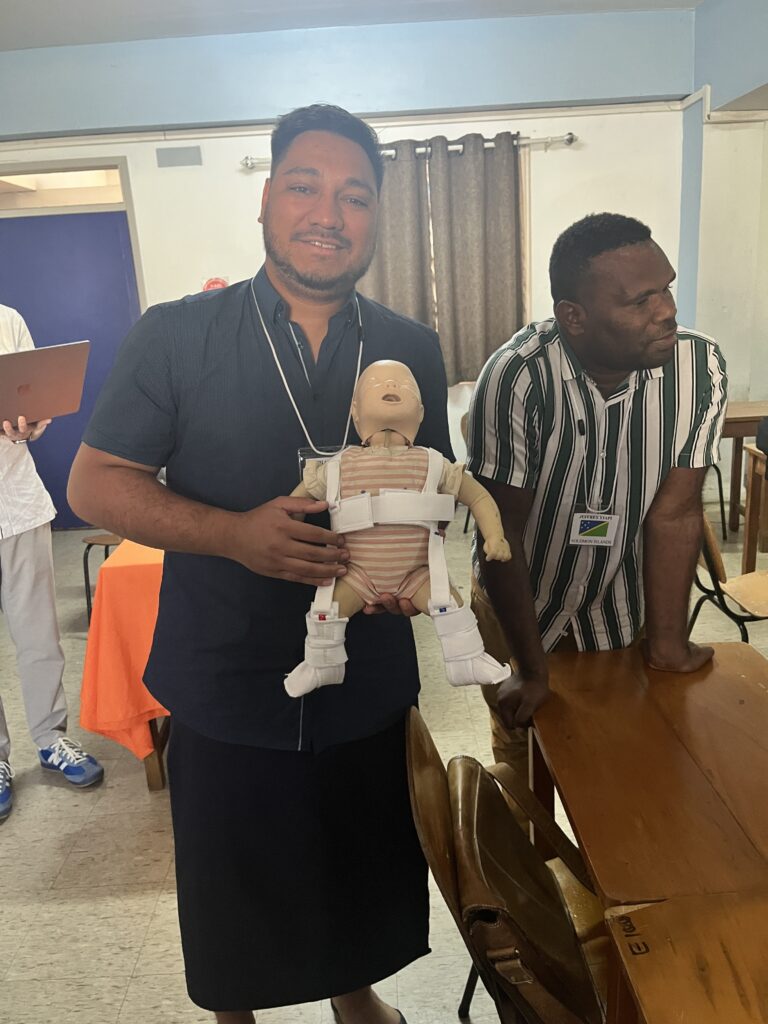
Michaelangelo Leota (Samoa ) and Jeffrey Yiapi (Solomon Islands with Pavlik harness
Thursday started off with 2 bed ward rounds , a young gentleman 25M with open tib/fib and ipsilateral tibial plateau fracture. The second case is a young gentleman 27M with left pertroch fracture from a MVA. Talks with lower limb trauma in children, scoliosis/spondylolisthesis, spina bifida, osteogenesis imperfecta, clubfoot and Ponseti casting practical in the afternoon.
Friday we skip the 2 bed ward rounds to accommodate visit to Lautoka special school at 8.30am. we saw 3 cases with cerebral palsy and a case of Klinefelter’s syndrome. We return to the lecture rooms and start on module exams. The answers for true and false questions were reviewed after the exams with the students. The day ended with group photographs.
Front row: Koen de Ridder, Tim Gregg and Jason Donovan from New Zealand. Back row from L to R Vanua Ilo from Vanuatu, Micahel leota from Samoa, Jeffrey Yiap from Solomon Islands, Des Soares, Australia, Manoa Valeniyasana from Fiji, Robert Faataga from Samoa, Oralae Pitakia from Solomon Islands, Mark Rokobuli from Fiji, Taukoriri Tibriano from Kiribati, Stephen Waro from PNG, Tzun Rafael from Palau, Paul Lomavatu from Fiji and Reshwin Rajan from Fiji.
The Hip Module started off on Saturday 8th March with similar structure of basics in history taking and Hip Examination on the first day. The morning started off with a handover of local team admissions and we continued to our 2 bed rounds split into 2 groups. Each group is led by a lecturer. The topics covered include hip fractures and pelvis Fractures and variety of management options.
Dr David Rovinsky gudigin students with sawbones
The goals of getting early surgery for neck of femur fractures (NOFs) were stressed and the need for other teams involvement, like our anaesthetists and physicians colleagues. A literature bank was created to contribute articles that will help other teams understand approach to NOFs management. Other conditions of the hip including paediatric conditions were covered and infections of the hip.
A variety of surgical approaches to the hip and acetabulum were covered. Practical stations held mostly in the afternoon and includes clinical stations of history taking and physical hip examination, cannulated hip screw, Dynamic Hip Screws(DHS) fixation, concepts/principles of Hip replacement. (see attached timetable). The module ended on Friday 14th and students and teachers leaving the next days.
Front from L to R David Rovinsky, Stepehn Kodovaru, Andy Vane, James Tewa’ani.
We would like to thank the funders of the modules, South Pacific Projects, AO Alliance, Orthopacifix, Various individual students sponsor Like WHO and Australias DFAT, the lecturers that came to teach out of their own costs.
Front from L to R Jeffrey Yiapi, Agnes Auto, Patrick Houasia, Clay Siosi, James Tewani.
We acknowledge Dr Patrick Houasia Head of department and the local Orthopaedic team, the National Referral Hospital and Ministry of Health Solomon Islands for hosting the modules and allowing us access to facilities and patients. We Thank The NRH kitchen for providing us meals and for Pacific Casino Hotel, Millys and Rekona lodge for accommodating our students and Lecturers. We Thank Des Soares for organizing the modules, preparing equipment, the logistics to get all of us to Honiara and ensuring the modules go as planned.
The Spine module started off on Monday 3rd Of March. The mornings start at 8am with a handover of the local team admissions and reviews and students are welcome to participate in the discussions. Then we moved to 2 Bed ward rounds on selected cases picked the previous day for a deep dive into history taking and clinical exams, which each student takes turns examining clinical signs at bed side. We then moved to the classroom to start lectures, mostly talks in the morning and practical stations in the afternoon.
Topics covered over the week include basics of History Taking and Spine physical exams trauma cervical spine and lower spines, infections, degenerative conditions and paediatric spine conditions and their management (detail timetable attached). The practical stations include history taking scenario (Dr and Patient), students partner to carry out spine examination, dura repair exercise on water filled ballons, setting up skull traction, laminectomy and pedicle screws and posterior lumbar fusion on sawbones.
We were able to see a good number of patients with spine trauma admitted in the ward that provided an opportunity for demonstrating clinical signs. The spine module ended on Friday 8 March with an assessment exam. Because of the cyclone in Queensland, Drs Ben and Alpesh had to leave early on Thursday via Fiji and we adjusted our sessions to accommodate the change. Dr Mich and Cheung were able to continue to the end.
Front from L to R Ben Funaki (NZ), Alpesh Patel (NZ), Stephen Kodovaru (Solomon Is) Mich Atkinson (Aus) Ian Cheung (Aus) Second row Lto R Manoa Valeniyasana (Fiji), Jacky Pahun (PNG), Tommy Walters (PNG) Tzun Rafael (Palau), Johnny Hedson (FSM), Oralae Pitakia (Solomon Is), Thomas Kiele (PNG), Back row L to R Micahel Leota (Samoa), Agnes Auto (Solomon Is), Robert Fa’ataga (Samoa), Jeffrey Yiapi (Solomon Is), Vanua ilo (Vanuatu), Viola Kokiva (PNG), Haynes rasin (PNG), Steven Kutukana (Solomon Is)
There was great rejoicing at the formal graduation ceremony held in Apia, Samoa on 4 April 2025. 4 PIOA students were awarded a Master of Surgery (Orthopaedics) by the National Univeersity of Samoa. This brings to 12 the total number of graduates from the PIOA programme.
From L to R : Dr Naseri Aiotato (Am. Samoa), Dr Juvencio Dias (Timor Leste), Dr Anthony Nasai (Papua New Guinea), Dr. Reshwin Rajan (Solomon Is / Fiji)From L to R : Dr Areta Samuelu, Samoa) Dr Naseri Aiotato (Am. Samoa), Dr Juvencio Dias (Timor Leste), Dr Anthony Nasai (Papua New Guinea), Dr. Reshwin Rajan (Solomon Is / Fiji), Dr Shaun Mauiliu (Samoa)
Dr Shaun Mauiliu (2019) and Dr Areta Samuelu (2022) are previous graduates of the PIOA program and now serve on the faculty of Miedicine at the National University of Samoa teaching orthopaedics. They are also emplyed as orthopaedic surgeons at TTM Hospital Apia.
You can view the entire graduation ceremony here https://www.facebook.com/watch/live/?mibextid=wwXIfr&ref=watch_permalink&v=1026564382724927&rdid=BsSPOmzhWrlzxvRp
The PIOA upper limb module included sessions on microsurgery using loupes and microinstruments which were provided to the students to take back with them.
Here Dr. Tommy Walters from Lae in Papua New Guinea (PNG) writes “Hi Des . I used my loupes today for a Radial nerve exploration and repair (Male 50, bush knife wound left distal humerus/elbow). It was really helpful. Thank you for my loupes. Tommy.”
Sadly, PNG is rife with violence and bush knife injuries are common. Tommy’s new skills will be very useful for the people of Lae.
Middle image : Blue – proximal end. Green distal end just approx. 0.5-1mm from where it divides into Superficial and deep branches.
The next training modules in Spine and Hip will be held in Honiara, Solomon Islands from 3-7 March 2025 (Spine) and 8-14 March, 2025 (Hip). PIOA last held a module in Honiara in September 2017, so we are looking forward to returning th the National Referral Hospital (NRH) which was the inaugural training site for the PIOA program and hosted every module from 2013 to 2016.
2017 Hip Course.(From L to R) Dr Vaughan Poutawera (NZ), Dr Silent Tovasia (First Solomon Island orthopaedic surgeon), Dr Hermann Oberli (pioneer of orthopaedic surgery in Solomon Islands (Swiss)), Dr Andy Vane (NZ).
We will have 14 students from 7 countries (Papua New Guinea (5), Solomon Islands(2), Timor Leste (1), Fiji (2), Palau (1), Vanuatu(1) and Samoa(2). Lecturers from Solomon Islands, Australia, New Zealand and the United States (Hawaii) will assist with teaching.
PIOA graduates and trainees were invited to participate in the International Society of Limb Salvage (ISOLS) 24 meeting in Brisbane.
PIOA is very grateful to Peter Steadman and Prof. David Wood for organising a special workshop to develop tumour services for the Pacific.
PIOA graduates Areta Samuelu (Samoa), James Tewa’ani (Solomon Islands, Juvencio Dias (Timor Leste) and trainees Viola Kokiva (PNG) Tommy Walters (PNG) and Pauliasi Bauleka (Fiji) and prospective trainee Jenny Tovu (PNG) with Eka Wiratnaya (faculty from Bali).
From L to R Shaun Mauiliu (examiner), Juvencio Dias (Timor Leste candidate), Des Soares (Deputy Director Training), Reshwin Rajan (Solomon Is / Fiji candidate), Raymond Saulep (PNG – unsuccessful candidate), David Bartle (examiner), Anthony Nasai (PNG candidate) and Andreas Loefler (examiner)
The PIOA exit exams follows the approximate format of the AOA / RACS exams. There are 2 written papers with 10 short answer (1 page) questions each. There are 2 Operative surgery computer vivas (with 5 cases in each) and 1 Imaging and Investigation computer viva (with 5 cases). There are 2 clinical vivas (with upto 5 patients in each). In all, there are 45 clinical scenarios assessed and the exam is mapped to ensure a wide coverage of the curriculum.
The written exams and computer cases for Operative surgery and Imaging and Investigation were prepared by Dr Richard Lander with assistance from Dr John North. Unfortunately both Dr Lander and Dr North became unwell shortly before the exams and were unable to be there as examiners. Dr. Lander did provide advice to the examiners at the final examiners meeting. PIOA is grateful for the dedicated servcie over many years by Dr Lander and Dr North.
The examiners were Dr Andreas Loefler from Australia, Dr David Bartle from New Zealand and Dr Shaun Mauiliu from Samoa who have all been examiners for PIOA previously.
There were 4 candidates and 3 were successful.
PIOA congratulates the following successful candidates
Dr Anthony Nasai, first PIOA graduate from PNG (with Haynes Rasin from Bougainville, PNG)
Dr Juvencio Dias, first PIOA graduate from Timor Leste
Dr Reshwin Rajan, Solomon Islands / Fiji (with fellow Solomon Islands trainees Oralae Pitakia, Jeffrey Yiapi and Agnes Auto)
The PIOA Upper Limb and Reserach methods modules were held in Apia, Samoa from 16-27 Spetember 2024.
Module 2 was held at the Tupua Tamasese Meaole (TTM) Hospital in Apia, Samoa from 16th to 27 September 2024. There were 12 trainees who attended the module. They are Dr. Robert Fa’ataga and Dr. Michael Leota from Apia in Samoa, Dr. Agnes Auto, Dr. Oralae Pitakia and Dr. Jeffrey Yiapi from Solomon Islands, Dr. Paul Lomavatu and Dr Manoa Valeniyasana from Fiji, Dr. Tzun Rafael from Palau, Dr. Julio Martins from Timor Leste and Dr. Thomas Kiele, Dr Haynes Rasin and Dr Tommy Walters from PNG.
Week 2 Back row from L to R, Faculty in bold, Paul Lomavatu (Fiji), Manoa Valeniyasana (Fiji), Tzun Rafael (Palau), Michael Leota (Samoa), Julio Martins (Timor Leste), Tommy Walters (PNG), , Robert Fa’ataga (Samoa), Thomas Kiele (PNG), Des Soares (Australia) and Shaun Mauiliu (Samoa), Front row from L to R Jeffrey Yiapi (Solomon Islands),.Agnes Auto (Solomon Islands), Graham Gumley (Australia), Jenny Green (Australia) Oralae Pitakia (Solomon Islands), Haynes Rasin (PNG)
The lectures were delivered by Dr. Shaun Mauiliu and Dr Areta Samuelu from Samoa, Dr. Roy Craig and Dr David Lees from New Zealand, Dr Graham Gumley, Dr Jenny Green, Dr Sarah Coll and Dr. Des Soares from Australia. Prof. Nik Friederich from Basle in Switzerland taught Research methods each morning via Zoom.
In this module, the students were taught a systematic approach to diagnosis and management of orthopaedic Upper limb conditions. This included clinical history taking and a thorough clinical examination, investigation and a structured, systematic approach to orthopaedic decision making. There was also an emphasis on a systematic approach to the management of upper limb conditions including the management of closed and open fractures and hand trauma. In addition, there were focussed lectures and practicals on the management of trauma affecting the long bones of the limbs, tendon repair and microsurgery techniques for nerve and vessel repair.
Lectures were supplemented with practical demonstrations. Each morning. we commenced with a ward round seeing two patients and getting the students to present the history and clinical signs of the patients. Their management was then discussed and suggestions for improvement were made. This was a useful exercise as we were able to improve clinical skills. It was also helpful to try and elucidate clinical reasoning and decision making and help with developing these skills. The students enjoyed having expert advice on the diagnosis and management of Shoulder and elbow conditions such as rotator cuff disease and frozen shoulder.
The students were assessed with practical tasks (history taking, focussed clinical examinations and a practical task (tendon repair on pork trotter, microsurgical nerve repair on Chicken Maryland (sciatic nerve) model as well as a written examination on the final day of the modules.
Roy Craig and Mano Valeniyasana with Agnes Auto, Tommy walters and Oralae Pitakia after a ward round.
The Research methods module was taught by Prof Nik Friederich by Zoom from Basle in Switzerland. Each day we began with a lecture and practical exercise aimed at understanding basic Research methodology including basic statistics and working throgh critical analysis of the surgical literature.
The exit exam was also held in the second week. There were 3 successful candidates Amthony Nasai (PNG), Juvencio Dias (Timor Leset) and Reshwin Rajan (Fiji / Solomon Islands).
Our thanks to the staff and patients of the TMM Hospital, Apia, and Lynn’s Getaway accommodation. Our special thanks to Bek’s restaurant who provided nutritious food for the duration of the course and made us feel at home.
Finally, this module would not have been possible without the generous financial support from the Pacific Community (SPC), Wyss Medical Foundation, AO Alliance Foundation, Australian High Commission, Palau and South Pacific Projects.
Final celebration dinner at SIVA AFI traditional Samoan cultural dinner including fire dancing.
Tommy Walters and Mano Valeniyasa na demonstrating closed management of proximal humerus fractures.
Jeffrey Yiapi learning to use his microsurgical instruments.
Student performed microsurgical nerve and artery repair on Chicken Maryland model.